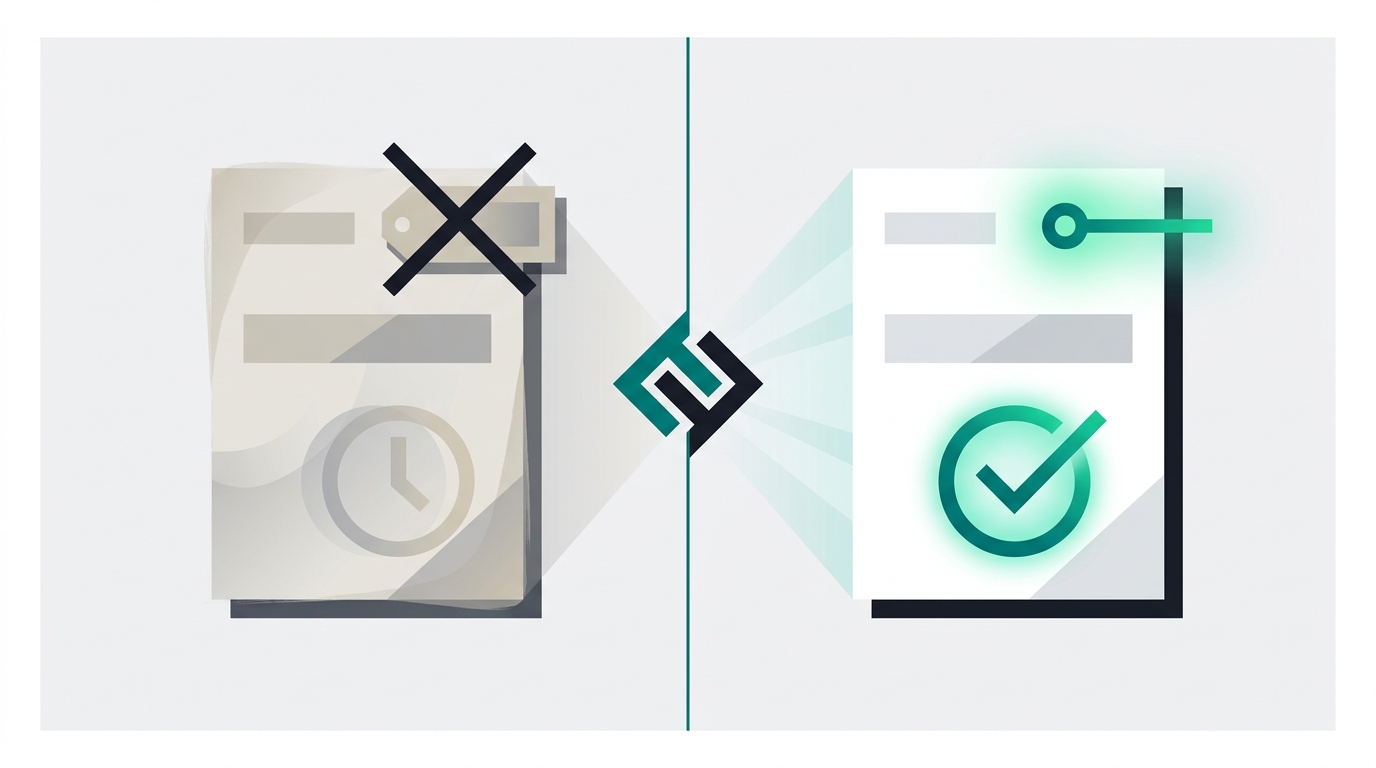

Optimizing pages for AI Overviews
Learn how to optimize pages for AI Overviews with answer-first structure, checkable claims, original visuals and a weekly fact-check workflow that improves citation odds.
Contents
Only 37.9% of pages cited in Google's AI Overviews appear among the top 10 result blocks, including SERP features, for the same query (ElmoHQ). That figure comes from an Ahrefs analysis of 863,000 keywords and 4 million AI Overview URLs (DesignRush).
So most cited pages are not the top-ranked ones. Getting cited is an evidence problem more than a ranking problem.
The pages that get pulled into AI Overviews tend to share three traits. They answer first. Each section makes sense on its own. They make claims a system can check.
Below is a workflow you can run every week: live research, a fact-check on every claim, original visuals, answer-first structure, schema as a minor supporting signal, a before/after audit template, and a publish-and-refresh loop.
What AI Overviews Pull From
Rank helps, but it doesn't decide who gets cited. In the Ahrefs data, 37.9% of cited pages appeared among the top 10 result blocks, 31.2% among result blocks 11 to 100, and 31.0% beyond the top 100 result blocks, including SERP features (ElmoHQ).
Google uses query fan-out, which may contribute to citations from outside the original result set (Digital Applied). Google splits one question into several smaller ones, and your page can get picked up by any of them.
Read these numbers with their methods attached. Ahrefs' July 2025 study put the top-10 overlap at 76%, but the two studies used different parsers and data, so the drop to 38% isn't a like-for-like trend (DesignRush).
BrightEdge, using a different method, found only about 17% of AI Overview citations overlapped with the organic top 10 (DesignRush). Over sixteen months, that share held steady around 16 to 17%, mostly from pages ranked 21 to 100 (Cicero Studio).
The spread between studies is the real finding:
- Published overlap estimates range from 12% to 93% (ElmoHQ).
- A peer-reviewed SIGIR 2026 study of 11,500 queries put source overlap between AI Overviews and the ranked SERP at a Jaccard of 0.18 (ElmoHQ).
Rank is neither necessary nor sufficient for citation.
Google's own position points the same way. Its official guide to generative AI features stresses unique, non-commodity content and pushes back on AEO and GEO myths (Google Search Central).
One step before any of this: search your target query and confirm an AI Overview appears. Respona recommends targeting queries that trigger AI Overviews in the first place (Respona). If none shows up, you're writing for a feature that isn't there.
Write Answers That Can Be Quoted
Put the answer in the first one or two sentences under each heading. Then add context.
Nearly every guide on this topic pushes answer-first writing, including Conductor and 20 North Marketing (Conductor; 20 North Marketing). What they skip is how to check those answers before you publish.
As an editing recommendation, make quotable sentences carry a checkable fact, such as a number, a name, a date or a price. Google's guidance favors unique, useful, non-commodity content (Google Search Central).
Compare two versions of the same point:
- Vague: "Many pages get cited even when they don't rank well."
- Specific: "31.0% of pages cited in AI Overviews rank outside the top 100" (ElmoHQ).
The second sentence can be lifted, quoted and verified. The first one can't.
Qualify a claim in the same sentence, not in a footnote. The Ahrefs 76% to 38% comparison only holds up if "different parsers and data" travels with it. A quoted fragment loses its surrounding paragraph, so the caveat has to live inside the sentence that gets quoted.
Then add something competing pages don't have. Position Digital recommends first-party data and unique information (Position Digital), and Conductor frames information gain as the deciding factor (Conductor). In practice, that means:
- Your own test results
- Your own prices
- Original diagrams built from your data
Structure Pages So Sections Stand Alone
Write one question per H2 or H3. Make each section readable with no context from the rest of the page.
Google uses query fan-out, which may contribute to citations from outside the original result set (Digital Applied). Position Digital's checklist makes the same point: plan for the sub-queries, not only the head term (Position Digital).
Build your sections from sub-questions. 20 North Marketing recommends People Also Ask for topic coverage (20 North Marketing). Take a parent query like "how to price a SaaS product" and break it into H2s:
- What pricing model fits a product with usage-based costs?
- How many tiers should a SaaS pricing page show?
- Should you publish prices or ask buyers to book a call?
- How often should you raise prices?
- How do you test a price change without losing customers?
Each one is a self-contained answer that a fan-out query can land on.
Repeat the subject by name in each section. Write "Search Console's AI report shows impressions only," not "it shows impressions only." An extracted section can't resolve a pronoun that points back three paragraphs.
Use original visuals that carry data, and put the source in the caption. Ignite Visibility covers image and video work for AI Overviews (Ignite Visibility). A labeled chart of your own numbers gives the page information nobody else has. Every Ryterr post ships with a hero image, inline images in your brand colours, and Markdown and HTML files (Ryterr).
Show Evidence and Sources Clearly
Sourcing is the core of the method. Every statistic, price, name and date links to a live primary source, inline, next to the claim. Finch recommends citing authoritative sources (Finch), but most guides stop at the advice and skip the checking.
Fact-check before publishing, not after. Google's guidance on AI-generated content is blunt: "It is critical to manually factcheck and review all AI-generated content for accuracy and trustworthiness before publishing" (Google Search Central). The same page warns that generating many pages without adding value may violate the scaled content abuse spam policy.
The loop looks like this: research, draft, verify each claim, correct, then review.
This is the part we built Ryterr around. Our checker, Trace, checks each statistic, price, name and date against live sources, and the Review tab lists every claim with the page it was checked against (how Ryterr writes a post). Corrections show the old words, the new words and the reason. On our sample post about deploying Next.js to an Ubuntu VPS, 25 of 25 claims were verified with no open warnings.
You can run the same check by hand. Copy this audit template:
| Claim | Type (stat, price, name, date) | Source URL | Source is primary? (Y/N) | Verbatim quote matches? (Y/N) | Caveat in same sentence? (Y/N) | Answer in first two sentences? (Y/N) | Section stands alone? (Y/N) | Original visual? (Y/N) | Last checked date |
|---|---|---|---|---|---|---|---|---|---|
Score the page before you edit it. Then score it again after.
Borrow the test design from Ahrefs' schema study: change one thing, keep a control group of similar pages, and compare citation changes over the same window (Search Engine Roundtable). AI Overviews are volatile, so a single page with no control tells you very little.
End every post with a visible Sources section and an FAQ. Every Ryterr post includes both by default.
Keep Technical Signals Clean
Eligibility comes first. Google's guide says "a page must be indexed and eligible to be shown in Google Search with a snippet" (Google Search Central). Check that you aren't blocking yourself with snippet controls like nosnippet, data-nosnippet or max-snippet (Ignite Visibility). The same guide ties eligibility to the Search generative AI features setting in Search Console.
Treat schema as a supporting signal, not a lever. The observational data looks strong: 53% of pages cited by AI carry schema, about three times the rate of uncited pages (YouMind, reporting Ahrefs Japan).
The controlled test tells a different story. Ahrefs tracked 1,885 pages that added JSON-LD between August 2025 and March 2026 and matched them against 4,000 control pages (Search Engine Roundtable). AI Mode rose 2.4%, ChatGPT rose 2.2%, and AI Overviews declined 4.6%, a decline Ahrefs did not attribute to schema (NQZ).
The study authors, Louise Linehan and Xibeijia Guan of Ahrefs, put it plainly: "If the only reason you're adding it is to get more AI citations on pages that are already visible, our data doesn't support that bet" (NQZ).
One limit applies: every test page already had 100+ AI Overview citations. The result doesn't tell you whether schema helps a new or low-authority page get understood. Some guides, including 20 North Marketing's, present FAQ schema as a strong driver of appearance. The controlled data doesn't support that claim for pages already being cited.
For markup requirements, read the current version of Google's guide rather than relying on summaries.
Keep the basics clean:
- Crawlable HTML
- Accurate titles, slugs and descriptions
- Visible, honest updated dates
Ryterr generates the title, slug and description with every post (Ryterr pricing).
How to Measure AI Overview Visibility
Start with Search Console's Generative AI performance reports. Google launched them on June 3, 2026, with data from May 18, 2026 and no backfill (Neil Patel). They've since rolled out to all websites worldwide, with breakdowns by pages, countries, devices and dates (Search Engine Journal).
Here's the tradeoff. The reports show impressions only: no clicks, CTR, position or queries (Neil Patel). You can see which pages earn AI impressions, but not which queries drive them. Pair the reports with manual spot checks on your target queries.
Then run this loop every week:
- Research the query and confirm an AI Overview appears.
- Write answer-first, with sections that stand alone.
- Fact-check every claim against a live source.
- Publish.
- Log AI impressions per page weekly in Search Console.
- Re-run the audit template on pages that are flat or declining.
- Refresh stale stats and re-verify them.
- Republish and record the date.
Conductor and Position Digital both list content refreshes in their recommendations (Conductor; Position Digital).
Steps 3 and 4 are where we fit. Ryterr publishes to WordPress, Ghost, GitHub, a signed webhook or the Content API, now or on a schedule (Ryterr integrations). A post with an open fact-check finding waits for your review instead of going out on a scheduled run. You read the report. You don't rewrite the draft.
Google is also changing how citations look. It has added more inline links and website previews in AI responses, and brought Preferred Sources and subscription labels into AI Overviews and AI Mode (Google). More visible links make each citation worth more, which is one more reason to get the claims right.
FAQ
Do I need to rank in the top 10 to be cited in AI Overviews?
No. In Ahrefs' data, 31.2% of cited pages appeared among result blocks 11 to 100 and 31.0% appeared beyond the top 100 result blocks, including SERP features (ElmoHQ). Ranking still helps, but sub-query coverage and specific, checkable answers matter too.
Will adding schema markup get my page into AI Overviews?
The best controlled evidence says no major uplift. Ahrefs' test of 1,885 pages found no major citation gain on any platform (Search Engine Roundtable). Those pages were already heavily cited, so treat schema as hygiene, not a growth tactic.
Can I see AI Overview clicks in Search Console?
No. The Generative AI performance reports show impressions only, with no clicks, CTR, position or queries (Neil Patel). Use manual SERP checks or a third-party tracker to fill the gap.
What makes a page eligible to appear at all?
Google says a page must be indexed and eligible to be shown in Search with a snippet (Google Search Central). Check for nosnippet or restrictive max-snippet settings first. Then check your Search Console settings for generative AI features.
How often should I refresh a page for AI Overviews?
We recommend checking AI impressions weekly and re-auditing any page that stays flat or declines. When you refresh, re-verify every stat against its live source, not only the ones you changed. Record the date so you can compare windows later.
Sources
- ElmoHQ: Rankings and AI citations
- DesignRush: AI Overview citations drop (Ahrefs)
- Digital Applied: AI search citation ranking factors 2026
- Cicero Studio: AI citations outside Google's top 10
- Google Search Central: AI optimization guide
- Respona: Google AI Overviews optimization
- Conductor: Strategies for Google AI Overviews
- 20 North Marketing: Content for AI Overviews
- Position Digital: Content for AI Overviews
- Ignite Visibility: Google AI Overviews
- Finch: Google AI Overviews and SEO
- Google Search Central: Using generative AI content
- Search Engine Roundtable: Schema and AI citations study
- YouMind: Schema markup and AI citations study
- NQZ: Structured data for AI search
- Neil Patel: Search Console generative AI report
- Search Engine Journal: Search Console AI reports rolled out worldwide
- Google: New controls for website owners
Audit one page this week
Pick one page that targets a query where an AI Overview appears. Run the audit template on it, fix every claim that lacks a live primary source, and log its AI impressions in Search Console for four weeks. If you want to see the same research and fact-check run for you, start with two free posts, no card needed, and compare our fact-check report against your audit.
Ryterr Team
Written with Ryterr: researched on the live web, written in our voice and fact-checked before publishing.